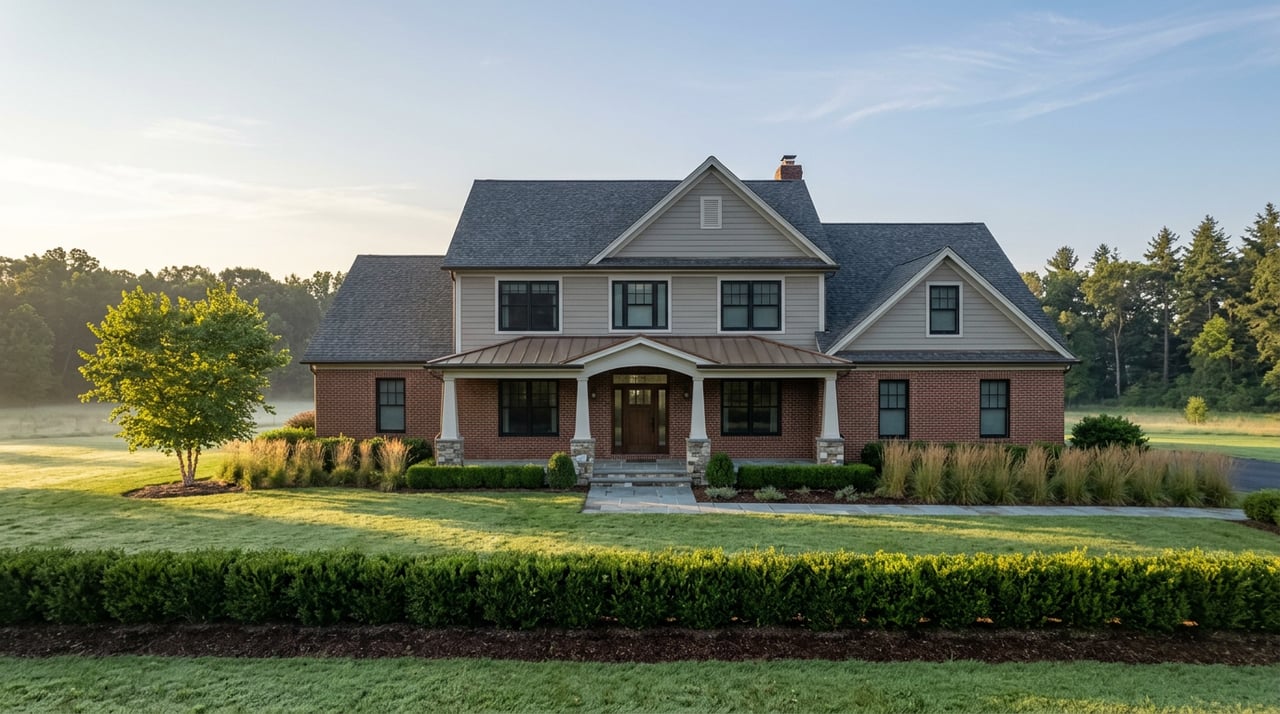
Why Oregon Doesn't Require a Septic Inspection Before You Buy in Turner
September 17, 2026
September 17, 2026
Most buyers assume a septic evaluation works like a home inspection: someone shows up, tests the system, and hands over a report that either clears the sale or stalls it. In Turner, that assumption can cost you leverage at the table. Oregon's Department of Environmental Quality is explicit that septic evaluations at the point of sale are voluntary, not mandatory. There is no state law that forces a seller to produce one, and no statute that stops a closing from happening without it.
That single fact changes the shape of a Turner purchase more than almost anything else in the transaction, because so much of the housing stock here still depends on private systems rather than city sewer.
The DEQ's own guidance puts it plainly: prior to purchasing a property with an existing septic system, you should hire a qualified inspector, but the evaluation itself is optional under state rule. If you do commission one, the inspector has to use DEQ's approved Existing System Evaluation form, and they need one of a short list of credentials, such as a DEQ installer certification, a maintenance provider certification, or status as a National Association of Wastewater Technicians inspector holding a sewage disposal service license.
What fills the gap left by that voluntary standard is whoever has the most leverage in the deal. A lender can still require an evaluation as a condition of the loan. Buyers can build one into their offer as a contingency. Sellers can order one proactively to head off negotiation friction. But absent one of those parties asking, nothing in Oregon law requires the system to be checked at all before the keys change hands.
Scroll through current listings in Turner and the language repeats: private well and septic, drilled well with a stated gallon-per-minute flow, septic approval already in hand, or a note that a prior well and septic have been abandoned and buyers need to start fresh. Acreage parcels on Turner's edges routinely carry these details because so much of the land outside the city's tighter subdivisions still sits on individual systems rather than a shared line.
Newer platted neighborhoods complicate the picture rather than simplifying it. Crawford Crossing markets itself around quick I-5 access and top rated schools, and Taylor Valley Estates has drawn buyers with views of Turner Lake and recent mechanical upgrades, but proximity to a subdivision name does not guarantee a hookup to municipal service. A separate acreage listing near Summit Loop, inside the Cascade School District, shows the same pattern from the other direction: a paved entrance into a new custom-home subdivision with no mention of city sewer at all. Enchanted Ridge, described in its own listing as the mid-valley's premier gated luxury community, has marketed lots with a recently drilled well rather than city water. The pattern holds across price points: buyers cannot infer sewer versus septic from the neighborhood name alone. It has to be verified parcel by parcel.
The city is also actively expanding its urban growth boundary, and Turner's own government has flagged UGB expansion as a live planning matter. As land moves from unincorporated county acreage into city limits, some of it eventually gains access to municipal sewer, but that transition happens parcel by parcel and year by year. A property just outside the current boundary today may still be running on a private system long after its neighbor two lots over gets city service.
Marion County Building Inspection Division issues septic permits as a contract agent of the DEQ, which means every step of the underlying system runs on state rule even though the paperwork crosses a county desk. If you want an existing system checked before you close, the county's evaluation process looks at more than the tank. A qualified inspector reviews the inlet and outlet baffles, checks for cracks or structural damage, and estimates solids accumulation in the tank. The state's broader guidance recommends having a tank pumped and inspected roughly every five to seven years, and flags that once solids exceed about 40 percent of tank capacity, it is time for a DEQ-licensed pumper.
A four-bedroom home is sized at 450 gallons per day under Oregon's onsite rules, which is why bedroom count, not square footage, drives how a system was designed to perform.
That bedroom-based sizing matters directly to a Turner buyer, because a fourth bedroom added without a corresponding system upgrade can mean the property is already running past its designed capacity. If a system was installed without a permit at all, and permits have been required in Oregon since 1972 with some counties requiring them earlier, that absence is itself information worth having before you make an offer.
Oregon State University's Extension well water program adds a practical note that surprises a lot of first-time rural buyers: there is no official pass or fail criteria for a septic system once it has been in operation for years, contrary to what some inspection marketing implies. The value of an evaluation is diagnostic, not a certification stamp, unless a lender specifically requires the formal form.
Turner's home price data tells a version of the same story: a single figure can look authoritative and still mislead you if you do not know how it was built. Earlier this year, one data source put Turner's median sale price at $435,000 for January 2026, down sharply from the year before. A few months later, a different tracker put the median closer to $587,000 for May 2026. Both numbers can be technically accurate and still point in opposite directions, because Turner sells so few homes in any given month that one or two high-acreage estate sales, or one cluster of modest ranch homes, can swing the median by six figures.
The same caution applies to the septic question. A single evaluation, a single inspector's opinion, or a single seller's assurance that "the system's fine" carries the same risk of overreading a small sample. The fix in both cases is the same: ask for the underlying detail, not just the summary number. For price, that means looking at comparable sales rather than the headline median. For septic, that means asking for the permit history and system size rather than accepting a verbal assurance.
Because Oregon will not stop the sale for you, the protection has to come from your own offer. A few things worth doing before you are deep into a transaction:
None of this replaces the county's process. It just means you are the one deciding whether that process happens, rather than assuming the state will decide it for you.
Does a septic evaluation slow down closing in Marion County? It can, since the county's Existing System Evaluation requires an inspector to complete a specific form and, in some cases, uncover parts of the system before the application is even accepted. Building that timeline into your offer early avoids a last-minute scramble.
What if the seller already had an evaluation done years ago? Ask for the date and the form. An evaluation from several years back tells you less about current condition than a fresh one, especially if the property has changed hands or added bedrooms since.
Is a septic system a dealbreaker if it was never permitted? Not automatically, but it is a real cost consideration. An unpermitted system may need to be brought up to current standards before certain financing or future additions are allowed, so price that risk into your offer rather than discovering it after close.
If you are weighing a purchase in Turner and want a clearer read on a specific property, from what a septic record actually shows to how a listing's price compares to real recent sales rather than a single swinging median, Jenny Morrow can walk through the details with you before you write an offer, not after. Let's connect.
Stay up to date on the latest real estate trends.








Jenny believes great results begin with understanding each client’s goals. She provides thoughtful guidance and strategic support throughout every step of the process. Clients trust her to deliver an experience that is both smooth and successful.